
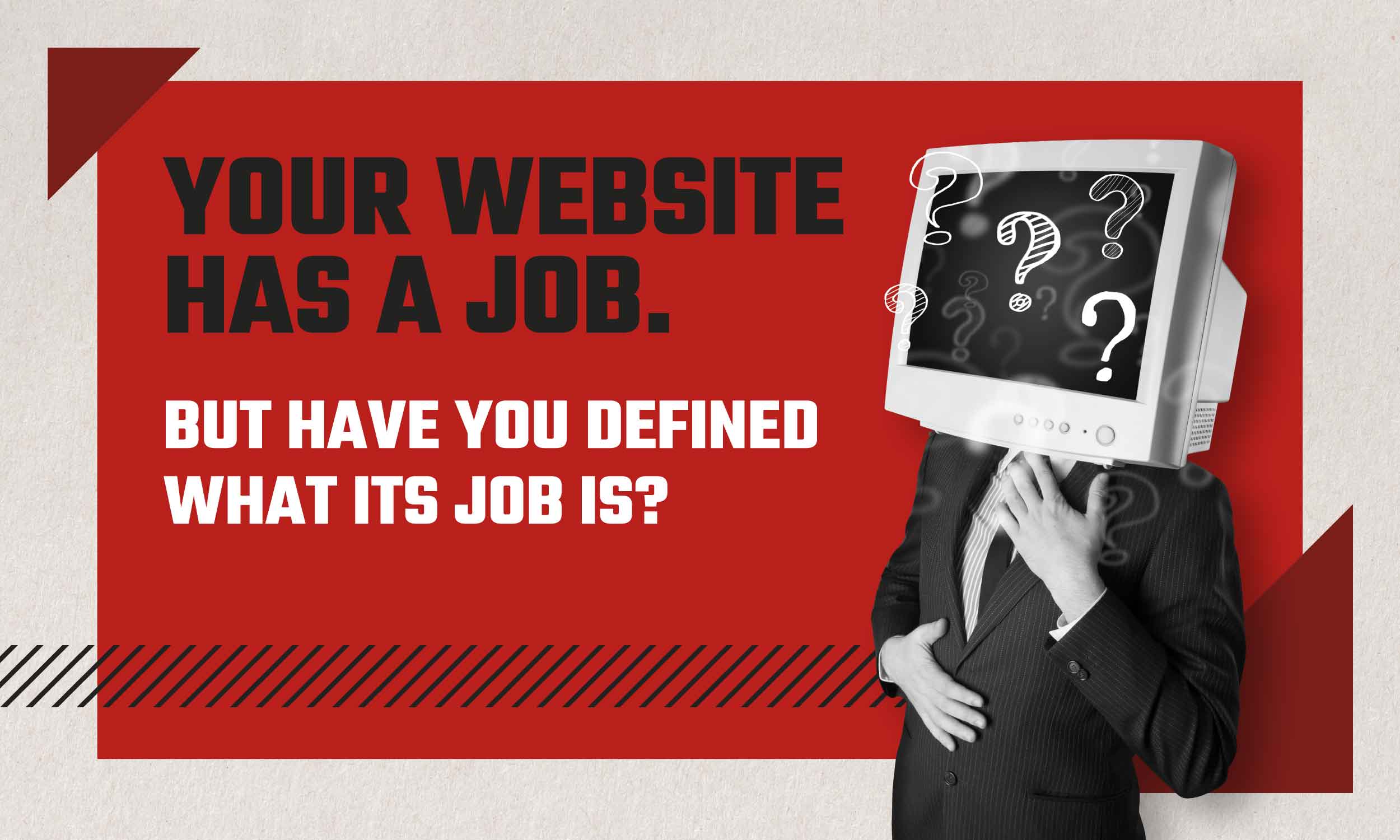
Your Website Has a Job. But Have You Defined What Its Job Is?
A website redesign can be exciting.
New colors. New photography. New navigation. New pages. Maybe even a sleek animation or splashy video.
Then launch day arrives, everyone celebrates, and six months later someone asks:
“Is the new website working?”
And that’s where things get awkward because before you can determine whether a website is working, you need to define what it’s supposed to do in the first place.
Too many businesses approach their websites as design projects rather than business tools. They know the old site looks dated, competitors have newer sites, or someone in leadership doesn’t like the homepage anymore. So they redesign it.
But a better-looking website isn’t necessarily a better-performing website.
Your website has a job (or three) but first you need to figure out what it is.
A Website Can Have More Than One Job
There’s no universal definition of a “good” website.
For one company, the primary goal might be generating qualified leads. For another, it might be helping existing customers find technical documentation. A manufacturer may need its website to educate prospective buyers about complex products, while a service company may primarily need it to drive phone calls and quote requests.
Other websites may be heavily focused on:
- Building brand credibility
- Supporting the sales team
- Recruiting employees
- Providing product specifications
- Answering customer questions
- Driving ecommerce sales
- Helping distributors find information
- Establishing authority in an industry
- Generating organic search traffic
- Supporting multiple stages of a long B2B buying journey
This is the important part: your website’s job should be connected to your business goals.
Start With the Business Problem
Before talking about fonts, photography, or whether the navigation should be on the left or right, ask a more important question: What business challenge are we trying to solve?
Maybe your sales team isn’t getting enough qualified opportunities. Or perhaps prospects can’t find product information without calling someone. Maybe customers are constantly asking your customer service team questions that could easily be answered on the website. Or the website still represents what your business was like five years ago.
Those are very different problems, and they can’t all be solved with the same website strategy.
A website redesign should start with the problem, not the homepage.
Don’t Make “More Traffic” the Entire Goal
Traffic is good. More visitors is better, right?
Not necessarily.
Imagine a website that gets 100,000 visitors a year but very few are potential customers. Now imagine another website that gets 10,000 highly relevant visitors who need the products or services the company provides.
Which one is performing better? (Hint: Not the one with more traffic.)
Traffic is an input. Business outcomes are the goal.
That doesn’t mean traffic isn’t important. Organic search visibility, referral traffic, paid traffic, AI assistants, and other acquisition channels can be extremely valuable. But they should ultimately connect your audience to something meaningful.
Depending on the business, that might mean:
- Qualified leads
- Quote requests
- Phone calls
- Product inquiries
- Downloads
- Demo requests
- Purchases
- Distributor inquiries
- Newsletter subscriptions
- Job applications
- Sales opportunities
The right metrics depend on the job you’ve assigned the website.
Your Website Should Help Answer the Buyer’s Questions
This is particularly important for B2B companies.
A prospective customer may not be ready to talk to sales when they discover your company. They may be researching a problem, comparing solutions, checking specifications, or trying to understand whether your product is even appropriate for their needs.
If the only meaningful call to action on your website is “Contact Us,” you’re asking every visitor to take the same step regardless of where they are in the buying process.
That’s not how people buy. A better website helps visitors find the information they need at each stage.
Early-stage visitors might need educational content. Someone further along may want product comparisons, specifications, case studies, or technical documentation. A ready-to-buy prospect might want pricing, a quote, or a conversation with sales.
Your website should support multiple journeys rather than forcing everyone through the same door.
Your Website Is Also a Sales Tool
Here’s another question worth asking: What questions do your sales team answer over and over?
Those questions are clues.
If prospects constantly ask about applications, specifications, installation, compatibility, pricing considerations, lead times, or differences between products, your website should probably address some of those questions.
That doesn’t replace your sales team. It makes your sales team more effective.
A good website can educate prospects before the first conversation, help salespeople share useful resources during the buying process, and give potential customers confidence that they’ve found a company that understands their needs.
In other words, your website shouldn’t just look like part of your sales operation. It should support it.
Don’t Forget About Search and AI
Your website also has a job to do before someone ever visits it.
People search for problems, products, companies, and answers. They use Google, social platforms, industry sites, YouTube, Reddit, and AI-powered tools to research their options.
That means your website needs to make its expertise understandable to human beings and the systems that help people find information.
That starts with useful, well-organized content that clearly answers the questions your customers are asking.
A beautiful website that nobody can find isn’t doing a good job, and a website that gets found but doesn’t answer the visitor’s questions isn’t doing its job particularly well either.
How Do You Know If Your Website Is Working?
Once you’ve defined the job, measurement becomes easier.
If the goal is lead generation, look at qualified inquiries and opportunities, not just pageviews.
If the goal is ecommerce, look at transactions and revenue.
If the goal is customer support, measure whether customers can successfully find the information they need.
If the goal is sales enablement, ask your sales team whether the website gives them useful resources and whether prospects arrive better informed.
If the goal is search visibility, track relevant organic traffic, rankings, conversions, and visibility across the search ecosystem.
And if the goal is a combination of these things, establish priorities rather than trying to make every metric equally important.
You can’t measure success until you’ve defined what success looks like.
Before You Redesign, Define the Job
The next time someone says, “We need a new website,” don’t immediately start talking about design.
Start with questions.
What isn’t working today? Who uses the website? What do those people need from it? What does the sales team need from it? What does the business need from it? What actions should visitors take? What questions should the website answer? And, how will we measure whether it worked?
Those answers should influence everything that comes next, from content and navigation to SEO, conversion paths, analytics, and design.
Because your website isn’t just another marketing expense. It’s a business tool.
The Bottom Line
Give your website a job. Define what success looks like. Then build the website to do that job well.
That’s where Dream Team Marketing comes in. We bring together web strategy, website design and development, SEO, content, analytics, conversion strategy and the other digital pieces that make a website more than a digital brochure. The goal isn’t simply to create a website that looks good. It’s to build one that can be found, understood, navigated and measured – and that supports the goals you’ve defined for it because strategy only gets you so far if the digital pieces aren’t working together.
Dream Team Marketing is a full-service marketing agency that uses creativity to connect your brand to your audience and help your business grow. We were founded to do what we are passionate about: Putting creativity to work and connecting brands to their audience, connecting audiences to your company goals, and connecting your business to the success it deserves.