
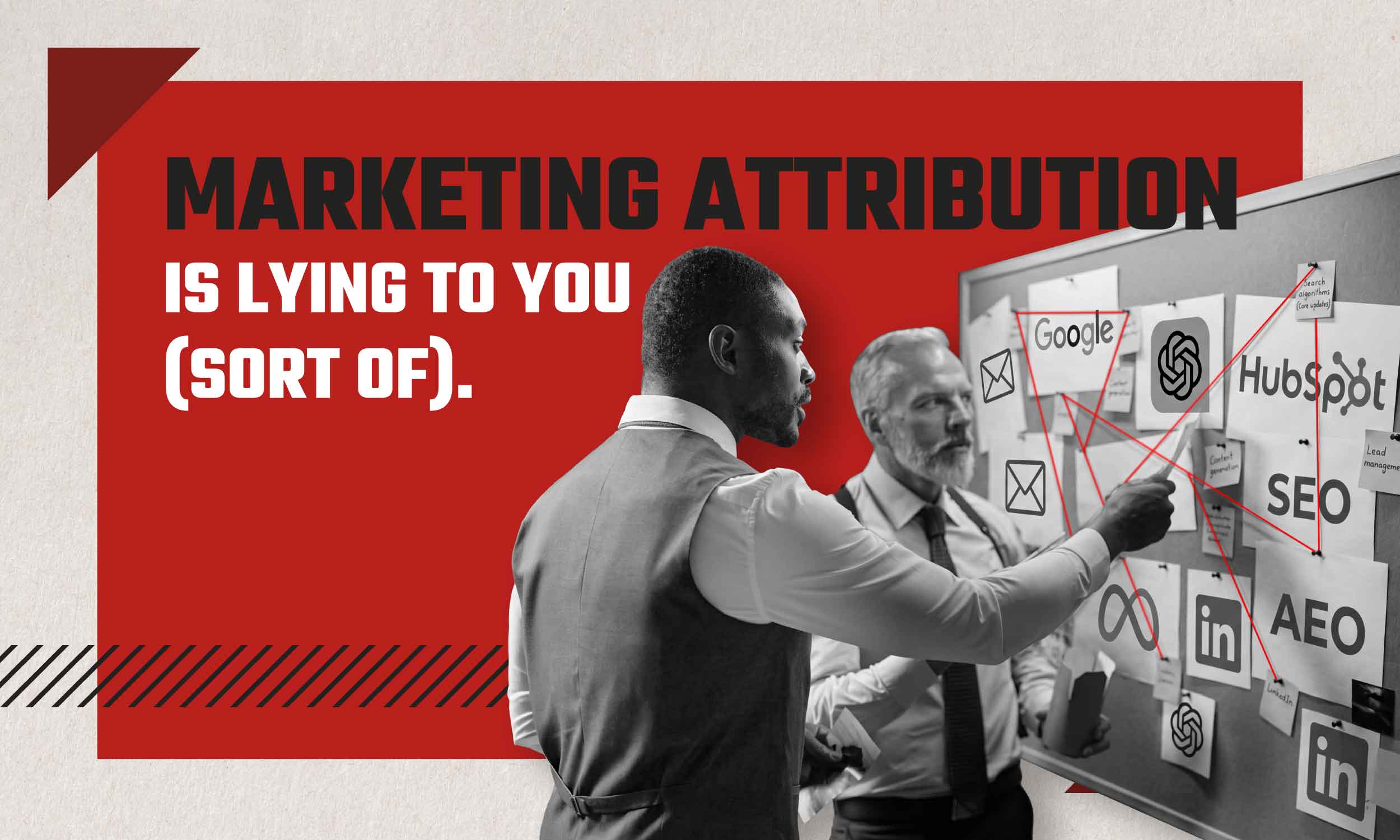
Marketing Attribution Is Lying to You (Sort Of)
The problem isn’t attribution. It’s believing attribution tells the whole story.
There’s a question marketers have been trained to answer: “Where did this lead come from?”
And we love answering it. Or trying to.
Google Analytics says organic search. HubSpot says email. Salesforce says referral. The CRM says LinkedIn. The salesperson says, “They saw our booth at the show six months ago.”
Which one is right? Maybe all of them.
That’s the problem, because modern B2B buyers rarely follow a neat little trail from first click to website to form to sales call to closed deal. They wander.
They search. They lurk on LinkedIn. They read a blog post. They ask ChatGPT. They visit your website three times without filling anything out. Someone forwards them an email. They mention your company to a colleague. They talk to a salesperson at a trade show. Then, six months later, they fill out a form.
Your marketing platform gets to see one piece of that journey and confidently announces:
“Organic search generated this lead.”
Technically? Maybe. Completely? Not even close.
Attribution Isn’t Broken. Our Expectations Are.
Marketing attribution is valuable. It can tell you which channels are generating traffic, conversions, leads, and revenue. It can help identify patterns. It can help you understand whether a campaign is doing what you expected it to do.
The problem starts when we treat attribution as a perfect record of why someone decided to buy because it isn’t.
Attribution systems are designed to track measurable interactions, but buyer behavior isn’t always measurable.
The Darker Side of “Direct Traffic”
Here’s another reason attribution gets messy. Someone types your URL into their browser.
Analytics says: Direct traffic.
Great. You generated a direct visitor. Except… Maybe they didn’t really type your URL.
Maybe they:
- Clicked a link in an email that wasn’t properly tracked.
- Clicked a link in a PDF.
- Came from an app or messaging platform.
- Followed a link from a document someone shared internally.
- Saw your company mentioned somewhere offline and searched for you later.
- Memorized your brand after seeing it repeatedly and finally came back on their own.
“Direct” often means “we don’t know.”
The Same Thing Happens With “Last Click”
Last-click attribution is particularly seductive because people believe it gives a clean answer.
A prospect fills out a form and the last thing they did was click a Google ad. Paid search gets the credit.
But what if that person had:
- Read four of your articles?
- Watched a product video?
- Followed you on LinkedIn for eight months?
- Received three emails from your company?
- Attended your webinar?
- Heard about you from a colleague?
- THEN clicked on the Google ad.
The Google ad may have been the final interaction but it doesn’t necessarily mean it was the reason they converted.
That’s the difference between conversion attribution and decision attribution.
B2B Makes This Even Messier
B2B marketing has a particularly inconvenient relationship with attribution because the person who fills out the form may not be the person who ultimately buys. And the person who ultimately buys may not be the person who first discovered you.
One person finds your company through search. Another downloads the specification sheet.
Someone else talks to your sales rep. A procurement person visits your website. An executive recognizes your name from an industry event. And somewhere in the middle of all this, an AI tool may have recommended your company to someone researching potential vendors.
That’s not a funnel, it’s a network of interactions, and trying to assign 100% of the outcome to one interaction is a little like giving one player credit for winning the World Series because they happened to score the final run in Game 7.
And Now There’s AI
Things get even messier as buyers increasingly use AI tools during research.
Someone might ask an AI assistant: “What companies make aerospace-grade fasteners?”
The AI mentions your company. The buyer then searches your brand. They visit your site.
They read your technical content. They send your product information to a coworker. Eventually, someone fills out a form.
See the pattern?
What gets the credit? Maybe organic search. Possibly direct traffic. Or the form conversion.
And maybe nothing clearly identifies the AI interaction even though it was an important part of how the buyer discovered you.
The problem is that the buyer doesn’t care whether their interaction(s) fits neatly into your attribution model. They just care whether your company keeps showing up when they’re trying to solve a problem. That’s also the opportunity so we’ll repeat it: Your company needs to keep showing up when they’re trying to solve a problem.
So Should We Stop Measuring Attribution?
No. Attribution is still useful for questions like:
- Which channels are generating qualified traffic?
- Which campaigns are producing conversions?
- Which content is associated with pipeline?
- Where are we seeing engagement from target accounts?
- Which channels appear to influence opportunities?
- What happens after someone interacts with a particular campaign?
The mistake is asking attribution to answer questions it can’t reliably answer. Especially:
“What caused this customer to buy?”
Think in Signals, Not Just Sources
Instead of asking “Where did this lead come from?” Try asking “What signals did this buyer receive before they became a lead?”
Look at how you fit into their purchase journey:
Search. Were they able to find you when they had a problem?
Content. Did your content help them understand the problem or evaluate solutions?
Social. Did they repeatedly encounter your brand or expertise?
Email. Did you stay relevant after the initial interaction?
Website. Did the site give them the information they needed to keep researching?
Events. Did they interact with your people in the real world?
Sales. Did someone build the relationship or answer the question that finally moved things forward?
Referrals. Did another person lend your brand credibility?
AI. Are AI-powered search and recommendation tools surfacing your company and content?
None of these exist in isolation, and that’s our point.
The Better Question Isn’t “Which Channel Won?”
Marketing teams tend to turn attribution into a competition.
SEO versus paid search. Social versus email. Content versus events. Marketing versus sales.
But customers don’t experience your marketing department as a collection of competing channels. They experience one brand.
If your SEO brings someone in, your website educates them, your email keeps you on their radar, your sales team builds trust and your trade show presence reinforces credibility, it doesn’t really matter which one gets the biggest slice of the attribution pie, does it?
They worked together. That’s marketing.
What Should Marketers Do Instead?
Start with attribution, but don’t stop there. Use your analytics and CRM data to understand measurable behavior. Then add the things the technology can’t see perfectly.
Ask sales: “How did this opportunity actually find us?” Ask customers: “What made you choose to contact us?”
Look at:
- CRM source data
- Assisted conversions
- Customer journeys
- Account engagement
- Branded search trends
- Content engagement
- Event interactions
- Referral activity
- Customer interviews
- Win/loss feedback
- Pipeline and revenue by channel
Pay attention to the patterns.
If several customers say they first discovered you through search but chose you because your technical content demonstrated expertise, that’s useful information. If customers repeatedly mention seeing your brand at industry events before eventually contacting sales, that’s useful information too.
These experiences may not fit neatly into a single-source attribution report but it’s still valuable info.
Attribution Is a Tool. Not a Truth Machine.
Marketing attribution can tell you what happened in the data you can capture but it can’t always tell you everything that happened in a buyer’s head or what turned them from browser into buyer.
Bottom line, attribution isn’t lying to you. It’s just telling you the part of the story it can see.
And marketers need to be smart enough to know there’s usually more to the story.
The answer isn’t to measure less. It’s to look at the bigger picture. At Dream Team Marketing, we believe effective marketing connects the dots between channels, customer behavior and business goals because the most meaningful results rarely come from a single click.
Dream Team Marketing is a full-service marketing agency that uses creativity to connect your brand to your audience and help your business grow. We were founded to do what we are passionate about: Putting creativity to work and connecting brands to their audience, connecting audiences to your company goals, and connecting your business to the success it deserves.